

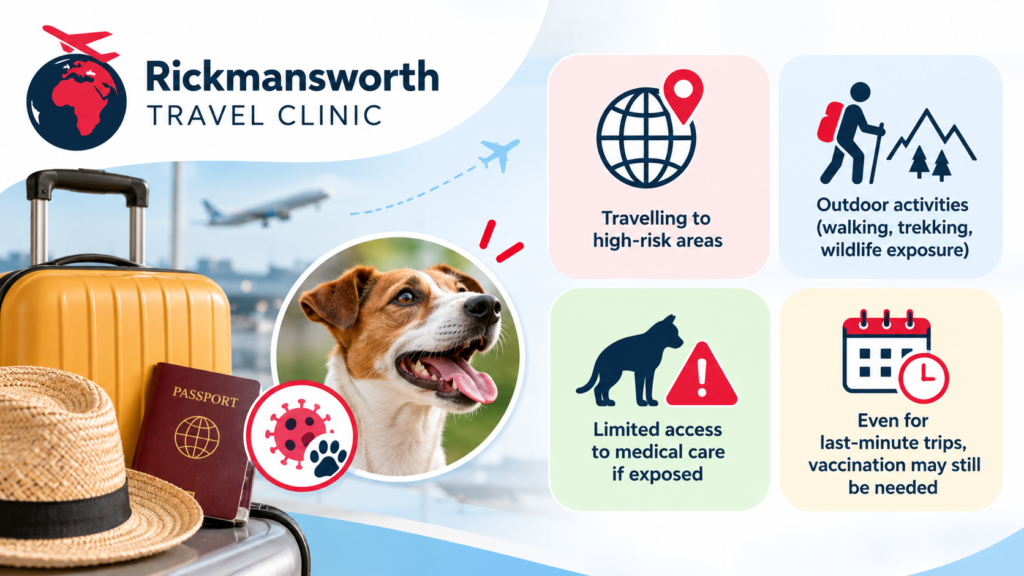
Quick Answer
You may still need a rabies vaccine before travel even when your trip is only days or weeks away. Vaccination is particularly worth considering for travellers visiting rabies-risk countries, remote locations or places with limited access to treatment. An accelerated vaccine schedule may be possible when there is not enough time for the standard course.
Introduction
Booking a last-minute holiday can leave little time to organise travel vaccinations. If your destination has rabies in animals, you may wonder whether you have left it too late to start vaccination.
The answer is not always yes or no. Your need for a rabies vaccine before travel depends on your destination, activities, length of stay, likelihood of animal contact and how quickly you could access reliable post-exposure treatment if you were bitten or scratched.
Rabies is a serious viral infection that affects the brain and nervous system. Once symptoms develop, it is almost always fatal. However, prompt preventive treatment before symptoms appear is highly effective.
Rickmansworth Travel Clinic provides rabies vaccination and personalised travel-health advice for travellers from Rickmansworth and surrounding Hertfordshire areas.
Key Takeaways
- Do not assume it is too late to ask about rabies vaccination.
- The standard UK pre-travel course uses doses on days 0, 7 and 28.
- An accelerated schedule may be available when departure is close.
- Remote travel and limited access to medical care increase the importance of pre-travel vaccination.
- Animal work, cycling, running and outdoor activities can increase exposure risk.
- Children may be more likely to approach animals.
- Vaccination does not remove the need for urgent treatment after a bite or scratch.
Who Should Still Consider a Rabies Vaccine Before a Last-Minute Trip?
Last-minute travellers should still consider vaccination when their itinerary puts them at meaningful risk of animal exposure or makes emergency treatment difficult to obtain.
UK travel guidance particularly highlights travellers visiting rabies-risk areas who will be staying remotely, taking part in activities such as cycling or running, working with animals or travelling somewhere where reliable post-exposure care may be difficult to access. Long stays of more than one month can also increase risk.
You may therefore need to discuss rabies vaccination if you are:
- Backpacking or travelling between rural areas
- Trekking, cycling or running outdoors
- Working or volunteering with animals
- Visiting areas far from hospitals or major clinics
- Staying for an extended period
- Travelling with young children
- Visiting places where dogs, monkeys or other mammals are commonly encountered
The decision should always be based on your individual itinerary rather than the country name alone.
Is It Too Late If You Travel Next Week?
Not necessarily. An accelerated rabies vaccination schedule may be available when there is not enough time for the standard course.
Under current UK guidance, the preferred pre-exposure schedule is:
Schedule | Vaccine Days |
Standard course | Day 0, Day 7, Day 28 |
Standard course when time is slightly shorter | Third dose may be given from Day 21 |
Accelerated course | Day 0, Day 3, Day 7 |
The accelerated course is specifically available when there is insufficient time to complete the usual 21–28 day schedule before travel. If someone continues to travel regularly to high-risk areas, further vaccination may later be advised.
This means that even travellers leaving relatively soon should speak with a travel-health professional rather than assuming they have missed their opportunity.
When Is the Rabies Vaccine Particularly Important?
Pre-travel vaccination becomes more valuable when getting urgent medical treatment after an animal exposure could be difficult.
Rabies post-exposure treatment needs to begin promptly after a significant exposure. In some destinations, access to suitable rabies vaccine or other required treatment may be limited.
Therefore, a traveller spending several weeks in remote villages may have a very different risk profile from someone staying near major hospitals in a large city.
Your travel-health assessment should consider:
- Exact destination and regions visited
- Length of stay
- Rural versus urban travel
- Planned outdoor activities
- Animal contact
- Local healthcare availability
- Previous rabies vaccination
At Rickmansworth Travel Clinic, rabies recommendations are based on these individual factors rather than applying the same advice to every traveller.
Which Animals Can Transmit Rabies?
Rabies can spread through the saliva of an infected mammal, usually through a bite or scratch.
Dogs cause most human rabies infections worldwide. However, cats, monkeys, bats and other mammals may also carry and transmit the virus.
This is especially relevant for travellers visiting temples, beaches, wildlife attractions or areas with stray animals.
An infected animal does not always look aggressive or visibly ill. For this reason, avoid touching, feeding or attempting to rescue unfamiliar animals while travelling.
Children require particular supervision because they may approach animals and may not always report a small scratch or bite.
Pre-Exposure Vaccination vs Post-Exposure Treatment
Pre-travel vaccination prepares your immune system before a possible exposure, while post-exposure treatment is given after a bite, scratch or other significant contact.
Pre-Exposure Vaccination | Post-Exposure Treatment |
Given before possible exposure | Given after a possible exposure |
Useful for higher-risk travellers | May be required urgently after contact |
Makes later treatment simpler | Must not be delayed |
Does not remove future treatment needs | Depends on previous vaccine history and exposure |
One of the biggest misunderstandings about the rabies vaccine is that vaccinated travellers can ignore an animal bite.
That is incorrect.
Even if you completed a pre-travel rabies course, you still need urgent medical advice after a possible rabies exposure. However, people who are already fully vaccinated generally require a simpler post-exposure vaccine schedule than people who have never been vaccinated.
What Should You Do After an Animal Bite or Scratch Abroad?
Wash the area immediately and seek medical care locally without delay, even if you received rabies vaccination before travelling.
If a dog, monkey, cat, bat or other potentially infected mammal bites or scratches you:
- Wash and flush the area thoroughly with soap and plenty of water.
- Apply a suitable disinfectant if available.
- Cover the wound with a simple dressing.
- Seek medical attention locally as soon as possible.
- Tell the healthcare professional about any previous rabies vaccinations.
Do not wait until you return to the UK to begin assessment or treatment.
UKHSA specifically advises travellers to obtain local medical care promptly because post-exposure treatment works by preventing disease before symptoms develop.
Does Having the Rabies Vaccine Mean You Are Fully Protected?
No. Pre-exposure vaccination provides important protection but does not mean you can ignore future animal exposures.
If you are bitten, scratched or licked on broken skin by a potentially infected animal, you still need professional medical assessment.
Vaccination is valuable because it primes your immune system and can simplify the treatment required after an exposure.
However, avoiding unnecessary animal contact remains one of the most important preventive measures.
How Can You Reduce Rabies Risk While Travelling?
The simplest prevention strategy is to avoid direct contact with unfamiliar mammals.
Do not pet or feed stray dogs and cats, even if they appear friendly. Likewise, avoid touching monkeys at temples, beaches or tourist attractions.
Keep food, bags and personal belongings secure around monkeys because attempts to take food or objects can lead to bites and scratches.
Children should understand that they need to tell an adult immediately if an animal bites, scratches or licks them.
Remember that a very small scratch can still require medical assessment if the skin has been broken.
What Are Common Misconceptions About Last-Minute Rabies Vaccination?
“There is no point if I travel next week.”
Not necessarily. An accelerated pre-exposure vaccination schedule may be possible when the standard course cannot be completed.
“I only need the vaccine if I work with animals.”
No. Travellers may also need vaccination because of remote travel, outdoor activities, long stays or limited access to post-exposure care.
“Only aggressive dogs transmit rabies.”
Incorrect. Rabies can occur in dogs, cats, monkeys, bats and other mammals, and infected animals do not always appear aggressive.
“Once I am vaccinated, I do not need treatment after a bite.”
False. Seek urgent medical care after possible exposure even if you were vaccinated before travelling.
“I can wait until I return to the UK.”
No. Treatment should begin locally when indicated. Do not delay urgent medical assessment after an exposure abroad.
How Can Rickmansworth Travel Clinic Help?
Rickmansworth Travel Clinic provides rabies-risk assessment and pre-travel vaccination for travellers in Rickmansworth and nearby Hertfordshire areas.
The clinic offers rabies vaccination alongside other travel vaccines, including Hepatitis A, Typhoid, Yellow Fever, Japanese Encephalitis and Tick-Borne Encephalitis.
The team can review your destination, travel dates and activities and explain which vaccinations may be appropriate, including options when your trip is approaching quickly.
Rickmansworth Travel Clinic
3 Tudor Way, Berry Lane
Rickmansworth
WD3 4DF
If your departure date is close, contact the clinic as soon as possible rather than assuming vaccination is no longer worthwhile.
People Also Ask
Can I get a rabies vaccine one week before travel?
Possibly. UK guidance allows an accelerated Day 0, 3 and 7 schedule when there is insufficient time for the standard course. A clinician should confirm whether this is appropriate.
How many rabies vaccine doses do travellers need?
The standard UK pre-exposure course consists of three doses, normally on Days 0, 7 and 28.
Who needs the rabies vaccine before travelling?
It is particularly considered for travellers with increased animal-exposure risk, remote itineraries, long stays or limited access to reliable post-exposure treatment.
Do I need rabies treatment if I was already vaccinated?
Yes. You still need urgent medical assessment after a potential exposure, although the treatment schedule differs for previously vaccinated people.
Can a monkey scratch transmit rabies?
Potentially, yes. A scratch that breaks the skin may represent an exposure, particularly if contaminated with saliva.
Should children have rabies vaccination before travel?
It may be considered depending on destination and risk. Children can be particularly vulnerable because they may approach animals or fail to report minor exposures.
Conclusion
Having last-minute travel plans does not automatically mean you have missed the opportunity to get a rabies vaccine.
The standard UK pre-exposure course uses three doses on Days 0, 7 and 28. However, when time is limited, an accelerated Day 0, 3 and 7 schedule may be considered following professional assessment.
Vaccination is particularly important to consider if your trip involves remote areas, animal contact, outdoor activities or destinations where urgent rabies treatment may be difficult to access.
Most importantly, vaccination does not replace emergency treatment after an exposure. If an animal bites, scratches or licks broken skin while you are abroad, wash the area immediately and seek local medical care.
If your trip is approaching quickly, contact Rickmansworth Travel Clinic to discuss whether rabies vaccination is appropriate for your itinerary.
Frequently Asked Questions
Rabies does not normally circulate among UK land mammals, although certain bats can carry rabies-related viruses. Travel-related exposure remains the main concern for most travellers.
Once clinical symptoms appear, rabies is almost always fatal. This is why prevention and prompt post-exposure treatment are so important.
Yes, in some circumstances. An accelerated schedule may be available following a travel-health assessment.
Rabies vaccines used for travellers are generally well tolerated. Mild injection-site soreness, headache or tiredness can occur.
No. Recommendations depend on the exact destination, activities, length of stay and access to treatment.
Yes. Monkey bites and scratches in rabies-risk countries should receive prompt medical assessment.
Wash the area thoroughly and seek urgent local medical advice if you are in a country where rabies is present
No. Seek medical care locally without delay.